Summary
I built "Sarah", an AI voice agent that makes sales calls in English and Arabic for a used-engine dealer in Sharjah. The client tested the Arabic version on a real phone call and approved it. But I could not take it live.
The AI was not the problem. The phone line was. UAE law does not ban AI sales calls, but the business first needs government approval and a local number registered in its name. The phone services I tried could not give me a UAE number that is allowed to make calls. In October 2026 I told the client honestly that calling could not go live as planned, and offered a chat-first WhatsApp assistant instead.
The client and the goal
The client sells used Caterpillar and Komatsu engines, diesel pumps and parts from Industrial Area, Sharjah. His buyers are in the UAE, other GCC countries, Africa and Asia. He wanted an AI agent that could call buyers one by one, introduce the stock, and pass serious buyers to him.
The plan was simple:
- I add lead names and phone numbers.
- The system calls them one by one.
- Sarah talks to each buyer in their language.
- The result of each call is saved, and the owner gets an update on WhatsApp.
My role was to build and test it myself, not just advise. The work up to this point was an unpaid pilot.
What I built
Sarah runs on Vapi. Every call goes through three steps: speech-to-text hears the buyer, a language model decides what to say, and text-to-speech speaks the answer.
- English agent: Soniox for speech-to-text, Claude Haiku 4.5 as the brain, ElevenLabs Flash v2 for the voice.
- Arabic agent: a separate agent written in Syrian (Shami) dialect, because that is how the client's buyers speak.
- One agent per language: I tested automatic switching between Arabic and English in one agent. It did not work reliably — the agent kept answering in English. Separate agents, chosen by each lead's language, was the safer design.
- "Rule Zero" prompt: Sarah may only say what is written in her prompt. Anything else goes to the owner. The prompt also covers voicemail, gatekeepers, callers who don't speak the language, and catalogue requests.
- Knowledge base: example CAT and Komatsu engine models, approximate price ranges for the demo, and a question bank of what buyers usually ask.
- Browser demo: a web page on Netlify with the Vapi web widget, so the client could talk to Sarah from his laptop without any phone number.
The automation around Sarah was designed but waited on the phone side: Airtable for leads and call results, Make.com to start each call, and WhatsApp updates to the owner.
What worked
By 1 October 2026 the agent itself was working in both languages. Getting there took one failure first.
| When (2026) | What happened |
|---|---|
| Early September | First demo underperformed. Sarah had strict rules but no real product data, so she could not answer real questions. The client also tested her like a Q&A bot, not as a cold caller. |
| September | Built a knowledge base: engine models, buyer questions, competitors, and a list of facts only the owner could fill in. |
| 25 September | Rebuilt English first, with a new speech-to-text model. It finally understood my accent well. |
| 28 September | English demo page working with good answers; sent to the client. |
| 1 October | The client tested the Arabic version himself on a real call and approved it. |
The main lesson from this part: a voice agent with no product knowledge is useless, however good the prompt is.
Where it hit the wall
Test calls worked. Going live legally did not. Every way I tried to get a real phone line hit a platform rule, a phone-company rule, or UAE law.
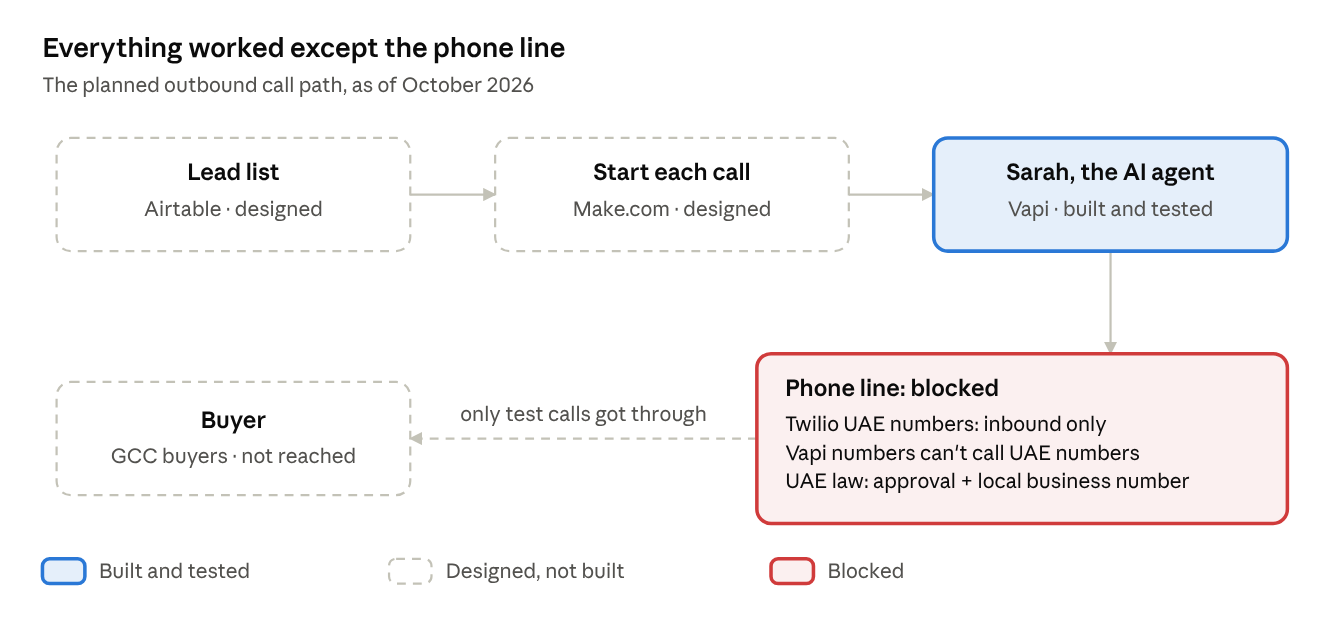
The agent was built and tested. The lead list and the call trigger were designed, but they all waited on the one step no provider could give: a legal phone line.
| Route I tried | What happened |
|---|---|
| Vapi's own numbers | Free Vapi numbers can only call US numbers, up to 10 calls a day. No international calls (Vapi support). |
| Twilio trial account | Could not import the number into Vapi on a trial account. |
| Telnyx | Several verification stages, including a review of the AI-calling use case. Not something you finish in days. |
| Twilio UAE number | It can only receive calls. Twilio's rules ban making calls from a UAE number by any route (Twilio terms). |
| Twilio US number | Fine for test calls to our own phones. Not a fit for real sales calls by a UAE business, and buyers see a foreign number. |
| WhatsApp calling | Voice and video calls on WhatsApp are blocked in the UAE. Text and voice notes work (Gulf News, Simology, 2026). |
The law is the real wall, but it is not a ban. Since 27 August 2024, Cabinet Resolution No. 56 of 2024 covers every UAE-licensed company that markets by phone, free zones included (Al Tamimi). AI and automated calls are allowed, but only if the business follows the rules. Before making sales calls, it must:
- get prior approval for telemarketing from the competent authority
- call from a local number registered with a licensed UAE telecom provider
- say who is calling and why, record every call, and tell the person it is recorded
- skip anyone on the Do Not Call Register or who already said no, and call only between 9 am and 6 pm
Resolution No. 57 sets the penalties. Calling without approval alone can cost AED 75,000 the first time, rising to AED 150,000 the third time.
Most of the client's buyers are in other GCC countries, and each has its own telecom rules. I could not get a clear answer that sales calls to them from a foreign number were allowed. I was not willing to risk the client's trade license on a guess.
Three questions, not one
"Can the AI talk?" is only the first question. A real AI calling system needs a yes to all three.
| Question | Answer for this project |
|---|---|
| Can the AI hold a sales conversation? | Yes. Built and tested in English and Arabic. |
| Can a phone provider carry the call? | Not from a UAE number, with the providers I tried. |
| Is the call allowed? | Only after approval, from a registered local number, and within each buyer country's rules. |
A provider being able to connect a call does not mean the call is legal.
The decision
On 3 October 2026 I told the client directly that outbound AI calling could not go live the way we planned, and explained why. I did this before taking any payment for the full system.
On 7 October I offered a different build that works inside the rules: a chat-first WhatsApp AI sales assistant. WhatsApp messages and voice notes work normally in the UAE, so the AI can do most of what Sarah was meant to do, in writing:
- chat with buyers in their own language
- reply to voice notes with voice notes
- send stock photos of engines and parts
- alert the owner when a buyer looks serious
- let the owner take over any chat himself
WhatsApp has its own rules too: a business should only message people first if they agreed to hear from it. So this design works best when the buyer starts the chat.
How the new flow works
- Buyers find the business through its website, search, or other legal channels.
- Their details go into Airtable or Google Sheets, with where the lead came from and whether they agreed to be contacted.
- The AI chats with them on WhatsApp or email, in their own language.
- It asks the key questions: which engine or part, machine model, location, and quantity.
- When a buyer is serious, the owner gets a short summary.
- If the buyer asks for a call, a person calls, or a calling setup that meets the rules.
The goal stays the same — find serious buyers for the owner — without depending on cold calls.
What I am not claiming
This case study shows a tested prototype and what I learned. It does not show:
- an approved telemarketing setup
- a working UAE phone line for real calls
- live sales calls to real buyers
- any numbers on sales or conversions
I will claim those only when they actually happen.
Lessons learned
- Ask "which number will it call from?" on day one. In the UAE that question decides the whole project. I asked it too late.
- Building the AI is the easy part. Phone numbers, carrier rules and telemarketing law took more time than the agent itself.
- Demo in the browser first. I wasted days setting up phone numbers before the agent was even good. A web demo needs no number and shows the client the real thing.
- An agent is only as good as its data. Strict rules with no product knowledge gave a polite agent that could not answer anything.
- One agent per language. Mixing Arabic and English in one agent was unreliable. Separate agents were simpler and sounded better.
- Say "this can't go live" early. Telling the client the truth cost me the calling project, but it kept his license out of risk and kept his trust.
- In the UAE, chat is often the better channel. WhatsApp messages and voice notes work everywhere here; calls are heavily controlled.
What a compliant launch would need
Outbound AI calling from the UAE is possible, but it is the business's project, not just the developer's. Based on what I found, it needs:
- Telemarketing approval, applied for by the business itself
- A local number registered to the business with a licensed UAE operator (du or e&), connected to the voice platform
- A recording notice at the start of every call, built into the agent's script
- A Do Not Call Register check before each call, and a dialer that only calls between 9 am and 6 pm
- Written legal advice for each GCC country the buyers are in
The simpler path is inbound. Twilio's terms allow a UAE number to receive calls, so an AI agent that answers buyers who call in avoids most of the outbound problems. This is not legal advice; any real launch should be checked with a UAE lawyer.
Bottom line
Building an AI voice agent is a software problem. Deploying an AI sales caller is a software, telecom and legal problem. I would not give up on AI here — I would start with the channels that are allowed, and add calling only when all three questions get a yes.
Tools and sources
Tools: Vapi, Soniox, AssemblyAI, Deepgram, Claude Haiku 4.5, ElevenLabs, Twilio, Telnyx, Netlify, Airtable, Make.com, WhatsApp Business API. I used Claude as a build partner for prompt drafting, research and code.
Sources:
- Cabinet Resolution No. 56 of 2024 (UAE Legislation)
- New UAE Telemarketing Regulations — Al Tamimi & Company
- UAE telemarketing rules, incl. automated calls — Economy Middle East
- UAE Toll-Free and Geographic Phone Numbers — Twilio terms
- Phone calling — Vapi docs
- Vapi support thread on calling UAE numbers
- TRA confirms WhatsApp calls remain blocked — Gulf News
- UAE VoIP guide 2026 — Simology