Most articles on this topic are written by agencies selling you something or course-sellers funneling you into a program. This one is different. I'm an AI automation builder in Dubai, and I built the exact system most of these pages describe but never show: a WhatsApp lead-qualification agent for Dubai real estate. So instead of another list of vendor promises, here's how the technology actually works, where it genuinely helps a brokerage, and — just as important — where it doesn't.
Quick Answer
AI automation for Dubai real estate brokers means using AI agents and connected workflows to handle the repetitive front end of the sales cycle — capturing inquiries from Bayut, Property Finder, and WhatsApp, qualifying and scoring each lead, replying instantly in multiple languages around the clock, and routing serious buyers to a human broker. The goal isn't to replace agents. It's to make sure no lead goes cold because someone messaged at 11 PM in Arabic while the team was asleep.
5 Key Takeaways
- The bottleneck is response speed and language, not lead volume. Dubai brokers already get inquiries; they lose them after hours and across language barriers. That's the specific problem AI automation solves.
- Lead qualification is the highest-value automation, not chat for its own sake. Scoring leads HOT/WARM/COLD so brokers spend time only on real buyers is where the leverage is.
- The hard part is conversation memory and structured output, not the chatbot. A system that forgets context after one message is useless; one that tracks a conversation and returns clean, routable data is the actual engineering.
- AI can't value property, close deals, or replace local judgment. It handles the first 80% of repetitive contact so you can do the 20% that requires a human.
- You can build this with no-code/low-code tools (Make.com, n8n, WhatsApp Cloud API, a knowledge base, and an LLM) — but the design decisions matter far more than the tool choice.
Why Dubai brokers are losing leads they already paid for
Dubai's property market is not a normal market. The Dubai Land Department recorded roughly 270,000 real estate transactions worth around AED 917 billion in 2025, a record year up about 20% on 2024. In the first half of 2025 alone, transactions hit 125,538 — up 26% from the same period a year earlier. That's an enormous volume of activity, and brokers are paying real money to portals and ad campaigns to capture a slice of it.
Here's the problem. A buyer clicks your Downtown Dubai listing on Bayut at 11 PM. They send a WhatsApp message asking about the payment plan — in Arabic, or Russian, or Hindi. By the time someone on your team sees it the next morning, that buyer has messaged four other listings and is already talking to whoever replied first. The lead you paid for is gone, and you never even knew it existed.
This is the structural gap in Dubai specifically. The market spans 200+ nationalities transacting at once, more than half of deals are off-plan, and buyers expect instant, multilingual answers at any hour. Manual processes can't cover that surface area. You're not losing leads because they weren't interested. You're losing them because you couldn't respond fast enough, in the right language, at the wrong time of day. That's exactly the failure AI automation is built to remove — and it's the reason this isn't hype for the Dubai market the way it might be elsewhere.
What "AI automation" actually means for a brokerage
The phrase gets thrown around to mean everything and nothing. Strip away the marketing and it comes down to four concrete functions working as a pipeline. Most vendor pages describe the outcomes of these; few explain the mechanics.
Lead capture across Bayut, Property Finder, and WhatsApp
Unlike Western markets dominated by a single portal, Dubai buyers arrive from Bayut, Property Finder, Dubizzle, Instagram, developer microsites, and WhatsApp groups all at once. The first job of any automation is to pull inquiries from these scattered channels into one pipeline so nothing lives only in an agent's personal inbox. Practically, this means inbound messages — especially on WhatsApp, where a large share of Dubai property conversations happen — hit a single system instead of a dozen disconnected places.
Lead qualification and scoring
This is the part that actually matters. Capturing a message is trivial; deciding whether the sender is a serious buyer is the valuable work. A qualification agent asks the right questions — budget, timeline, financing status, whether they're an investor chasing a Golden Visa threshold or an end-user — and then scores the lead so the broker knows where to spend their time.
In the system I built, every lead gets scored as HOT, WARM, COLD, or TOXIC based on conversation signals. HOT goes to a broker immediately. TOXIC (spam, tire-kickers, abusive messages) gets filtered out so nobody wastes a minute on it. That triage is the single biggest time-saver in the whole pipeline, because it inverts the broker's day: instead of wading through 50 messages to find 3 real buyers, the 3 real buyers come to them.
24/7 multilingual response
Dubai's buyer base doesn't operate on your timezone or in your language. An automation that replies instantly in English, Arabic, and Hindi — at 3 AM if needed — closes the after-hours gap that costs brokers the most leads. The point isn't to fake being human. It's to hold the conversation, answer the obvious questions about availability and payment plans, and keep the buyer warm until a real agent picks it up.
Follow-up and broker hand-off
Most leads don't convert on first contact, and consistent follow-up is where deals are won or lost. Automated, behavior-based follow-up keeps prospects warm without an agent manually tracking hundreds of threads — and when a lead shows real intent, the system hands off to a human with the full context attached, so the broker isn't starting cold.
How a real lead-qualification system is built
This is the section no agency listicle or course landing page will give you, because most of them are selling the outcome rather than showing the build. Here's the actual architecture of the WhatsApp lead-qualification system I built for the Dubai real estate use case. It's an MVP — a working demo, not a product with a roster of clients behind it — but the engineering is real, and it's the same pattern any serious build in this space has to solve.
The architecture
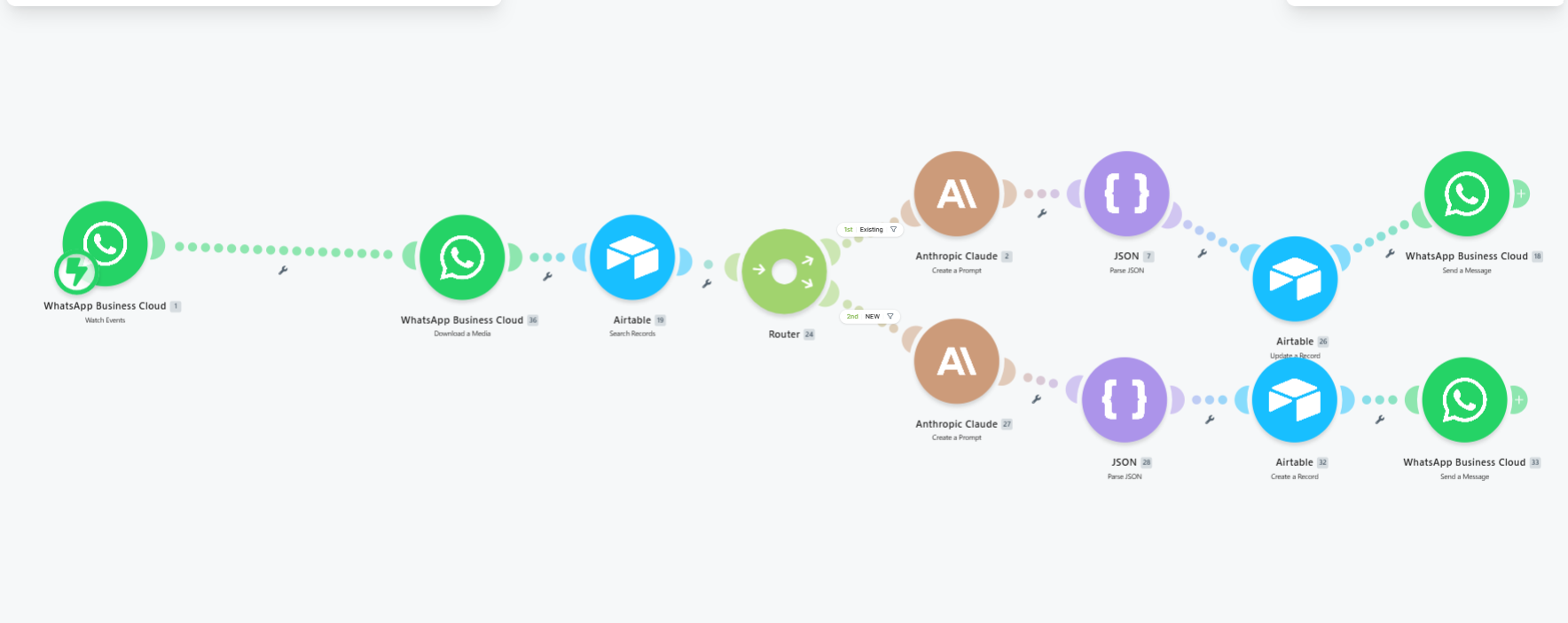
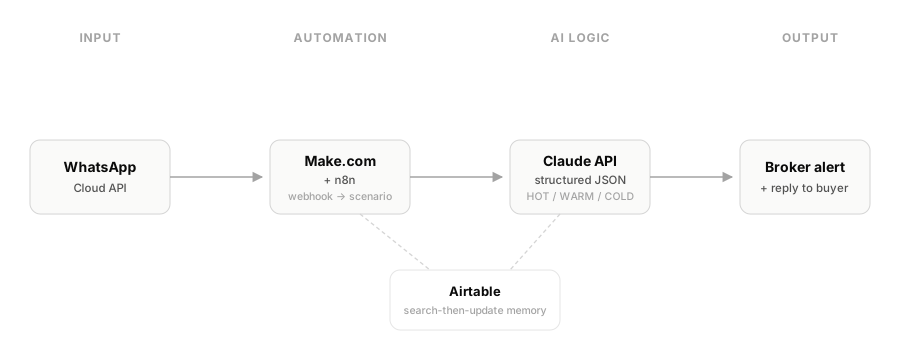
The system runs on no-code/low-code orchestration tools — Make.com and n8n — wired to the Meta WhatsApp Cloud API for messaging, the Claude API as the reasoning layer, and Airtable as the data store. When a buyer messages, the inbound webhook fires a scenario that passes the message to the LLM, gets back a structured decision, updates the record, and either replies to the buyer or notifies a broker. No heavy custom backend — the intelligence lives in how the pieces are connected and prompted, not in a from-scratch codebase.
Conversation memory: the search-then-update pattern
Here's the piece that separates a real system from a toy. A naive chatbot treats every message as if it's the first — ask it a follow-up and it has no idea what you said thirty seconds ago. Useless for qualifying a lead, which is a multi-message conversation by definition.
The fix is a search-then-update pattern against Airtable. On every incoming message, the system first searches for an existing record matching that contact, pulls the conversation history and current lead state, feeds that context to the model, then writes the updated state back. That's what lets the agent "remember" that this buyer already said their budget is AED 2M and they're after an off-plan unit — so it doesn't ask again, and the qualification actually progresses instead of looping. Conversation memory is the unglamorous core of the whole thing.
Structured JSON scoring and routing logic
The model doesn't just chat — it returns structured JSON that drives real business logic. Each turn, the LLM outputs a clean object: the lead score (HOT/WARM/COLD/TOXIC), extracted fields like budget and timeline, and the next action. Because the output is structured rather than free text, the workflow can branch on it deterministically — route HOT leads to a broker notification, hold COLD ones in a nurture state, drop TOXIC ones. Getting an LLM to reliably produce parseable, schema-consistent JSON instead of helpful prose is its own bit of engineering, and it's what makes the AI's "opinion" actually usable by the rest of the system.
What I learned migrating WATI to the Meta WhatsApp Cloud API
The system originally ran on WATI, a packaged WhatsApp platform. I migrated it to the Meta WhatsApp Cloud API directly, rebuilding the flow as a two-route Make.com scenario. The lesson worth passing on: packaged platforms get you live faster but box you in on logic and cost as you scale; going direct to the Cloud API is more work upfront but gives you full control over routing, memory, and how the AI layer plugs in. For a system whose whole value is custom qualification logic, that control was worth the rebuild.
If you're a broker or agency owner reading this and wondering whether something like this fits your operation, that's exactly the kind of thing worth a conversation — more on that below. First, the honest part.
What AI automation can't do for brokers (yet)
Every page on the first page of Google will tell you what AI can do. Almost none will tell you what it can't, because most of them are selling it. Here's the honest boundary, because trusting a builder means trusting them when they say "no."
AI automation cannot value a property in Dubai reliably on its own. Valuation models trained on US or UK data produce confident wrong numbers here — they don't understand off-plan payment-plan premiums, view premiums, or this market's supply dynamics. AI is a useful synthesis layer over real DLD data, not a substitute for it.
It cannot close a deal or build the relationship. Negotiation, reading a nervous first-time buyer, knowing when to push and when to wait — that's human work, and in a relationship-driven market like Dubai it's the actual job. Automation handles the repetitive 80% so the agent can focus on this 20%; it doesn't do the 20%.
It cannot replace local and regulatory judgment. RERA rules, DLD procedures, and what a Golden Visa threshold means for a specific buyer's strategy require accountable human knowledge. An AI can surface information; it shouldn't be the final word on compliance or advice.
And it won't fix a broken process. If leads fall through the cracks because of disorganization rather than speed, automating the chaos just produces faster chaos. The system works when it's layered onto a brokerage that knows what it wants to do with a qualified lead once it lands.
Being clear about these limits isn't a weakness in the technology. It's the difference between an honest build and an oversold one.
How to evaluate an AI automation build: DIY vs vendor
If you've decided this is worth pursuing, you have three broad paths. Here's how to think about them without the sales pressure.
| Path | Best for | Watch out for | |------|----------|---------------| | Off-the-shelf SaaS (packaged real-estate AI tools) | Getting live in days; standard workflows | Generic logic, recurring per-seat cost, limited control over qualification rules and memory | | Custom build (Make.com/n8n + Cloud API + LLM) | Brokerages wanting qualification logic tailored to their pipeline and languages | Needs someone who actually understands the architecture; more upfront design | | Agency engagement | Teams wanting it done for them, end to end | Verify the work is real — ask to see a working system, not just a slide of ROI claims |
A few questions that cut through the noise regardless of path: Can they show you a working system, not just promised outcomes? Can they explain how conversation memory works in their setup — if they can't, it probably doesn't? Does the qualification logic reflect Dubai-specific buyer profiles (off-plan vs secondary, investor vs end-user, Golden Visa eligibility), or is it a generic template? And be skeptical of any pitch leading with a precise ROI percentage and no methodology behind it — those numbers are usually marketing, not measurement.
Conclusion
The Dubai property market rewards speed, language coverage, and consistency — exactly the things humans can't sustain manually across 200+ nationalities and a 24-hour clock. That's why AI automation isn't hype here; it closes a real and expensive gap. But the value isn't in the chatbot. It's in qualification that triages your day, conversation memory that makes the agent actually useful, and structured logic that routes the right lead to the right broker at the right time. And it works best when you're honest about the line between what the machine handles and what only a person can.
Let's talk about your build
I build these systems, and I built the one described in this article for the Dubai real estate use case specifically. If you're a broker or agency owner thinking about where AI automation might fit — or you just want a straight answer about whether it's worth it for your operation — I'm happy to talk it through, no pitch. You can reach me at ahshakon@gmail.com.
FAQ
What is AI automation for real estate brokers? It's the use of AI agents connected to automated workflows to handle the repetitive parts of the sales cycle — capturing inquiries from portals and WhatsApp, qualifying and scoring leads, replying instantly in multiple languages, and routing serious buyers to a human broker. The aim is to stop leads going cold due to slow or after-hours response, while leaving negotiation and closing to the agent.
Will AI replace real estate agents in Dubai? No. AI handles the repetitive front end — first contact, qualification, follow-up — so agents can focus on the relationship-driven work that actually closes deals. In a market as relationship- and trust-driven as Dubai, negotiation and local judgment remain firmly human. Automation amplifies a good agent; it doesn't replace one.
Why is AI automation specifically useful in the Dubai market? Because Dubai's market has features most don't: 200+ nationalities transacting at once, more than half of deals off-plan, and buyers expecting instant, multilingual responses at any hour. Manual teams can't cover that timezone and language surface area, so leads leak after hours and across language barriers — precisely the gap automation closes.
What does lead scoring (HOT/WARM/COLD) actually do? It triages your inbound so you spend time only on real buyers. The system reads conversation signals — budget, timeline, financing, intent — and labels each lead. Hot leads go to a broker immediately, cold ones stay in nurture, and spam or time-wasters get filtered out. It inverts the workday: real buyers surface to you instead of you digging for them.
What tools are used to build a system like this? The build described here uses Make.com and n8n for workflow orchestration, the Meta WhatsApp Cloud API for messaging, the Claude API as the reasoning layer, and Airtable as the data store. The specific tools matter less than the design — how conversation memory, scoring, and routing are wired together is what determines whether the system actually works.
What's the hardest part of building one? Conversation memory and reliable structured output. A chatbot that forgets context after one message can't qualify anyone, so the system has to search for an existing lead, load its history, and update it on every message. And the AI has to return clean, parseable JSON the workflow can branch on — not free-form text. Those two problems, not the chat interface, are the real engineering.
Can AI automation value my listings or predict prices? Not reliably on its own, and you should be cautious about any tool that claims it can. Valuation models built on US or UK data produce confident wrong numbers in Dubai because they miss off-plan premiums, view premiums, and local supply dynamics. AI is useful as a synthesis layer over real Dubai Land Department data — not as a replacement for it.
Should I use an off-the-shelf tool or a custom build? Off-the-shelf gets you live fast with standard logic but limits control and adds recurring cost. A custom build takes more upfront design but lets the qualification logic match your pipeline, languages, and Dubai-specific buyer profiles. The right answer depends on how much your edge depends on tailored logic versus speed to launch.
How do I know if an AI automation provider is legitimate? Ask to see a working system rather than a slide of ROI percentages. Ask them to explain how conversation memory works in their setup — if they can't, it likely doesn't exist. Check whether the qualification logic reflects real Dubai buyer profiles. And treat any precise ROI claim with no methodology behind it as marketing rather than measurement.
How do I get started? Start by being clear about what you'd do with a qualified lead once you have one — automation amplifies a working process, it doesn't fix a broken one. From there, decide whether a packaged tool or a custom build fits your operation. If you want to talk it through without a sales pitch, you can reach me at ahshakon@gmail.com.